Account access and identity review
TrustDice Account and KYC Guide 2026
 Available in US
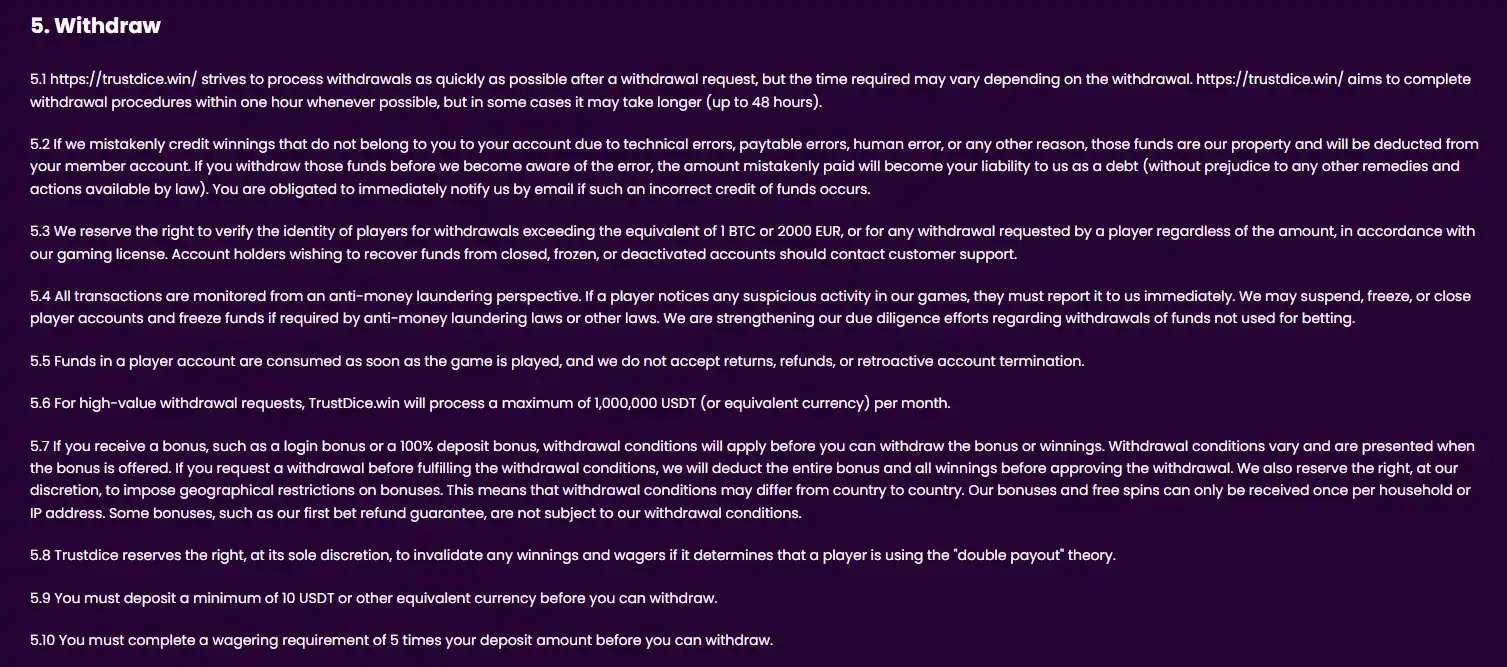
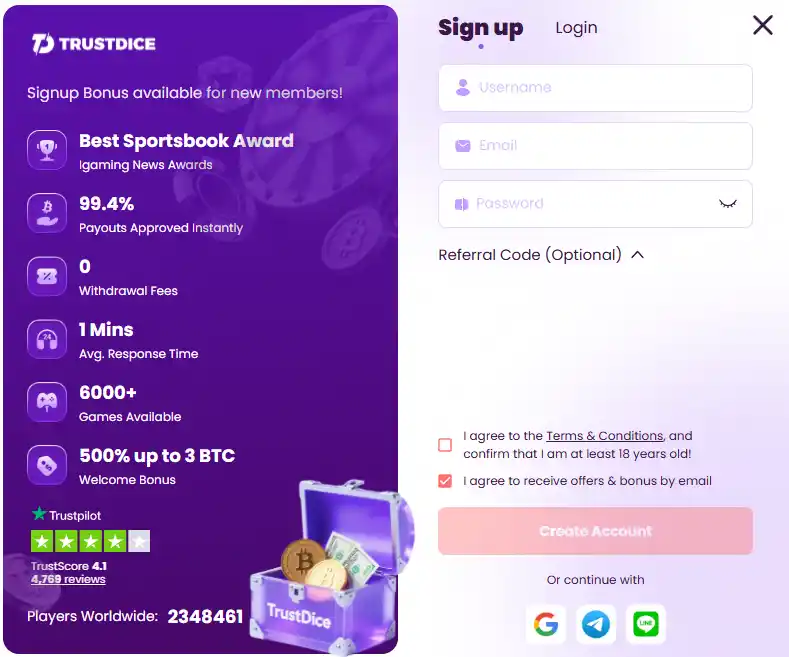
Independent reviews describe TrustDice as allowing users to start without mandatory upfront identity verification, while also noting that ID or address checks can be requested later, especially around withdrawals or risk and amount triggers. The useful distinction is therefore not “KYC or no KYC,” but when verification can enter the account lifecycle.
- Starting stage
- Initial access and later identity review are separate parts of the account flow.
- Later review
- ID or address checks can be requested at withdrawal or after risk or amount triggers.
- Fixed threshold
- Published figures differ, so a single universal trigger should not be assumed.
- Mobile access
- Browser-based access is available on iOS and Android.
Registration and verification are separate stages at TrustDice
Initial access and later identity review are separate parts of the account flow. That distinction reduces confusion at cashout: a low-friction start does not create a promise of permanent anonymity, and later review can still become relevant.
The practical distinction is chronological. Starting an account is one event; withdrawing funds is another. A user who plans only around the first event can be surprised when a later review asks for documentation. That is why “no upfront verification” is a more accurate description than treating TrustDice as a guaranteed no-KYC environment.
Start
Initial access and later identity review are separate stages.
Use
Account activity can later meet a risk or amount trigger that brings identity review into the process.
Withdraw
A cashout request can lead to ID or address checks, so withdrawal planning should include time for a possible review.
If your main concern is what happens after a cashout request, the TrustDice withdrawal guide separates transaction fees, minimums, payout timing and verification friction.
Withdrawal is where identity checks can become relevant
“Anonymous withdrawals” would be too strong a description. Independent reviews describe ID or address checks when withdrawing or when review triggers are reached. This makes cashout the stage where a privacy-first user should be prepared for the possibility of additional documentation.
| Account stage | What can happen | Reader implication |
|---|---|---|
| Start | The reported flow begins without a mandatory upfront identity check | Entry and later review should be treated separately |
| Ongoing use | Risk or amount triggers can lead to review | Do not build a plan around a fixed anonymous-use threshold |
| Withdrawal | ID or address checks can be requested | Allow for verification before expecting a completed cashout |
The withdrawal process also has a separate payment layer. Asset choice, network choice and any account review can affect the route to cashout, which is why the dedicated withdrawal section should be read alongside the account flow.
A fixed no-KYC threshold is not something to plan around
Published threshold figures differ, so there is no single number here that can be treated as a dependable no-KYC limit. That matters because threshold hunting can create the false idea that staying below one amount guarantees an unchecked withdrawal. The safer operational assumption is that identity review remains possible when a withdrawal or account pattern triggers it.
This also changes how privacy should be understood. Privacy at sign-up is about how much information is requested initially. Verification at withdrawal is about whether the operator later asks for evidence before releasing funds. Those two conditions can coexist. A user can therefore begin with little friction and still encounter a more demanding cashout stage.
- Do not treat “no upfront KYC” as a promise of anonymous withdrawals.
- Do not plan transaction sizes around a single threshold figure from an old review.
- Keep identity and address information accessible in case a withdrawal review requests it.
- Keep transaction records so the origin and destination of a crypto transfer can be reconstructed if needed.
For separate background, use the TrustDice License section. The account question here is narrower: when identity review can become part of the user journey.
Mobile web keeps the same account path on iOS and Android
TrustDice is accessible through mobile web on iOS and Android. That means the account flow can be handled in a browser without changing the underlying distinction between starting the account and a later verification review. Mobile access is a convenience layer, not a different identity policy.
On a phone, the most useful preparation is practical rather than technical. Keep enough screen space and time to read a verification request carefully, avoid uploading documents over an untrusted network, and check that the asset and network are correct before initiating any crypto transfer. Blockchain transactions are irreversible, so an account-security mistake and a transfer mistake can compound each other.
Good account habits
- Use a private device for account and document handling.
- Keep transaction IDs and withdrawal details until the transfer settles.
- Read any verification request fully before submitting information.
Common privacy mistakes
- Assuming browser access means identity checks cannot occur later.
- Using a fixed threshold as a guarantee against review.
- Rushing a crypto transfer while also dealing with an account check.
A simple verification flow reduces surprises at cashout
Because the exact trigger is not fixed, preparation works better as a sequence than as a threshold calculation. The goal is not to predict whether a check will occur. It is to make the account easier to handle if one does.
- Start with the understanding that the account flow can begin before an identity review.
- Keep the account details you provide consistent with any information you may later need to evidence.
- Before withdrawing, confirm the destination asset and network and keep the transaction information available.
- If an ID or address request appears, follow the account instructions rather than trying to infer a universal threshold.
- Allow additional time for a withdrawal if an account review is underway.
The same preparation helps when using the TrustDice welcome package. A bonus can require substantial turnover before cashout, so account-verification expectations should be understood before starting a long playthrough cycle.
Consistent records matter more than an anonymity label
The most useful account discipline is consistency. Keep the records needed to understand your deposits, wagering activity and withdrawal request; avoid changing the story around where a transfer came from or where it is going; and respond to a verification request based on the instructions shown in the account. This does not guarantee a particular outcome, but it reduces avoidable confusion when a review occurs.
It is also worth separating privacy preference from gambling risk. Less friction at registration can make access feel easy, but it does not reduce the financial risk of gambling, crypto volatility or irreversible transfers. Set time and loss limits before play, and do not use an account-access feature as a reason to increase betting volume.
Questions about TrustDice account verification
Does TrustDice require identity verification before I start?
Multiple independent reviews describe no mandatory upfront verification to start. They also state that ID or address checks can be requested later, including at withdrawal or when risk or amount triggers are reached.
Is TrustDice a no-KYC casino?
Starting without mandatory upfront verification is not the same as guaranteed no-KYC play. Identity checks can be requested at withdrawal or after account-review triggers, so a fixed anonymous-use promise would be misleading.
Is there a fixed TrustDice KYC threshold?
Published threshold figures differ, so there is no single threshold to rely on here. Plan for the possibility of an identity check when withdrawing or when an account reaches a review trigger.
What documents can TrustDice request?
If verification is triggered, the request can involve identity or address evidence. Follow the instructions shown in the account for the exact documents required.
Can I use my TrustDice account on mobile?
TrustDice is accessible through mobile web on iOS and Android, so the same browser-based account path can be used on supported mobile devices.
Plan for account access and withdrawal review as separate stages
TrustDice can be approached without treating sign-up and KYC as the same event. The account flow separates initial access from the possibility of later ID or address verification. Because published threshold figures differ, a fixed “no-KYC limit” is not a dependable planning tool. The practical model is simpler: expect low initial friction, but be ready for identity review when withdrawing or when the account reaches a review trigger.