Casino catalogue guide
TrustDice Games 2026: A Large Catalogue with Two Fairness Models
TrustDice combines a large third-party catalogue with live dealer tables and first-party crypto originals. Recent sources place the game library above 8,000 titles, while some list more than 10,000, so a range is more useful than one fixed count. The deeper distinction is structural: provider games rely on the provider’s normal game systems, while TrustDice originals such as Dice, Crash, Plinko and Wheel are described as provably fair and verifiable on-chain.
The catalogue is broad but not one uniform game type
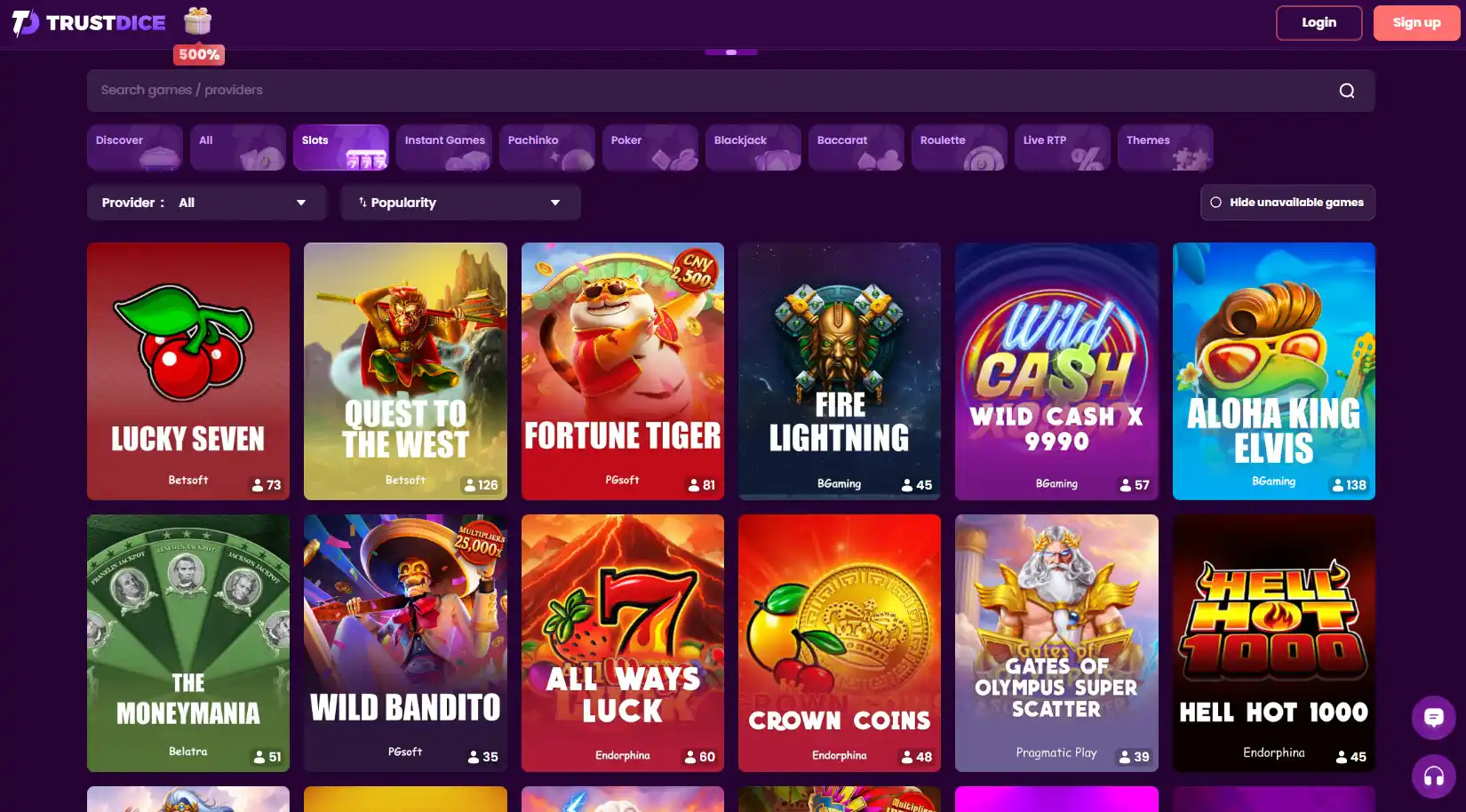
Published game counts do not agree closely enough for one exact number. Newer sources describe more than 8,000 games, and some list more than 10,000. The practical conclusion is simply that TrustDice has a very large catalogue. What matters more is how that catalogue breaks down, because a live dealer table, a third-party slot and an on-chain-verifiable Dice round are not interchangeable experiences.
Third-party casino games
Major providers supply the conventional catalogue, including slots and table-style content. These games are best understood through the provider, game rules and displayed information rather than TrustDice’s first-party verification model.
Live dealer tables
Live casino content is present, with Evolution and Ezugi among the named providers. The defining feature here is the streamed table and dealer interaction rather than on-chain outcome verification.
TrustDice originals
Dice, Crash, Plinko and Wheel are first-party originals described as provably fair. They form the part of the catalogue where individual outcomes can be checked through the platform’s on-chain verification approach.
The originals guide goes deeper into those first-party mechanics, while the provably fair guide focuses on what an on-chain record can and cannot prove.
Named providers cover slots and live content
Named providers include Pragmatic Play, Evolution, BGaming, NetEnt, Endorphina, PG Soft, Onlyplay, Betsoft, Ezugi, Play’n GO, Habanero, GameArt, Booming Games, Spinomenal and Belatra. Sources disagree on the exact total number of studios, so the names are more dependable than a provider count.
| Catalogue area | Named examples | What to check |
|---|---|---|
| General provider catalogue | Pragmatic Play, BGaming, NetEnt, Endorphina, PG Soft, Onlyplay, Betsoft, Play’n GO, Habanero, GameArt, Booming Games, Spinomenal, Belatra | Game rules, volatility or paytable information shown for the specific title. |
| Live casino | Evolution, Ezugi | Table limits, game variant and live-table availability at the time you play. |
| TrustDice originals | Dice, Crash, Plinko, Wheel | Verification record and the exact rules of the first-party game. |
This separation also prevents a common category error. A large provider list says something about breadth, but it does not tell you whether a particular title is provably fair, live dealer, or first-party. Those properties belong to the individual game model.
Provider identity is useful for a second reason: it gives you a stable way to compare game mechanics without treating the casino catalogue as one black box. A slot from a third-party studio follows that studio’s own rules and paytable presentation, while a live table follows the procedures of its live-game provider. A TrustDice original sits in a different category again because the verification path is part of the first-party game design. Starting with the provider or game family therefore narrows the questions you need to ask before playing.
Live casino is led by Evolution and Ezugi
TrustDice includes live casino games, with Evolution and Ezugi among the named providers. Live content is useful when you want a streamed table rather than a purely software-rendered round, but its trust model differs from the casino’s provably fair originals. You are watching a live game process; you are not using the same on-chain verification path described for Dice, Crash, Plinko or Wheel.
Live availability
Yes.
Named live providers
Evolution and Ezugi.
Verification model
Live dealer process rather than TrustDice’s on-chain original-game verification.
Useful check
Look at the specific table variant and limits before joining.
Catalogue size is a poor shortcut for choosing a live table. The table variant, limits and provider matter more than the total number of games elsewhere on the site.
TrustDice originals add on-chain verification
TrustDice’s first-party originals include Dice, Crash, Plinko and Wheel. Bitcoin-dice is part of the brand’s historical identity, and the current originals continue the crypto-native approach by adding provably fair verification. Each roll or spin is described as verifiable on-chain.
That changes the question you can ask after a round. Instead of relying only on a displayed result, you can inspect the verification data associated with the game and check whether the recorded outcome matches the provably fair process. It does not make a losing result profitable, remove house advantage or establish an audited RTP; it gives you a way to test the integrity of the result-generation process for supported originals.
- Open a supported TrustDice original such as Dice, Crash, Plinko or Wheel.
- Identify the verification information made available for the round.
- Compare the recorded inputs and result using the game’s verification path.
- Keep fairness verification separate from questions about expected return or volatility.
If you prefer conventional provider titles, this extra verification layer may not be the deciding factor. If you specifically want crypto-native mechanics, it is one of the clearest differences between TrustDice originals and the rest of the catalogue.
Provably fair changes what you can inspect
“Provably fair” is often used too broadly. In a useful sense, it means a player can verify that the outcome followed the committed inputs or cryptographic process rather than simply trusting a result shown on screen. TrustDice applies that idea to its first-party originals and describes the resulting rolls or spins as verifiable on-chain.
What verification can help you check
- Whether the recorded outcome matches the disclosed verification process.
- Whether the round data can be inspected after play.
- Whether a first-party original follows the stated cryptographic workflow.
What it does not establish by itself
- An audited RTP for the game.
- That a game has no house edge.
- That short-term results will resemble long-run expectations.
Fairness verification and RTP are separate questions. An on-chain record can help verify a round without establishing the game’s long-run return percentage or removing normal gambling variance.
Choose by game model, not catalogue size alone
A catalogue above 8,000 games creates choice, but it can also make browsing less informative if every title is treated as equivalent. A better approach is to decide which game model you actually want before browsing by provider or theme.
- Choose provider games when a familiar studio or conventional slot/table format is the priority.
- Choose live casino when the streamed dealer and table format matter more than cryptographic verification.
- Choose TrustDice originals when you want the platform’s provably fair, on-chain-verifiable mechanics.
- Read the rules of the exact game rather than inferring mechanics from the category name.
- Separate fairness verification from expected return, bankroll risk and short-term variance.
The bonus guide is also relevant if you are playing with a wagering requirement, because game eligibility and contribution rules can affect how a bonus behaves. Game eligibility and contribution rules can vary with the bonus terms, so check the live terms before assuming a title contributes to wagering.
Game catalogue questions readers usually ask
How many games does TrustDice have?
Recent sources describe a catalogue above 8,000 games, while some list more than 10,000. Because the published counts differ, the useful description is a large catalogue in that range rather than one exact total.
Which game providers are available at TrustDice?
Named providers include Pragmatic Play, Evolution, BGaming, NetEnt, Endorphina, PG Soft, Onlyplay, Betsoft, Ezugi, Play’n GO, Habanero, GameArt, Booming Games, Spinomenal and Belatra. The exact total provider count differs across sources.
Does TrustDice have live casino games?
Yes. TrustDice has live casino content, with Evolution and Ezugi among the named live providers.
Which TrustDice games are provably fair?
TrustDice has first-party provably fair originals including Dice, Crash, Plinko and Wheel. Their outcomes are described as verifiable on-chain; that verification is separate from any claim about profitability or an audited RTP.
Read next
- Explore TrustDice originals and their mechanics
- See how provably fair verification works
- Return to the full TrustDice review
The useful split is provider games versus verifiable originals
TrustDice offers breadth through a large third-party catalogue, recognizable provider names and live tables from Evolution and Ezugi, but its distinctive game layer is the first-party original catalogue. Dice, Crash, Plinko and Wheel add an on-chain-verification path that conventional provider games do not share. The game count is best treated as a broad 8,000+ to 10,000+ range rather than one exact total; the more useful choice is whether you want conventional provider content, live dealer play or a first-party game whose outcome can be checked through the provably fair process.
Written by the editors at TrustDice.